
Growth Experimentation & CRO
From CRO Programs to Continuous Growth Systems
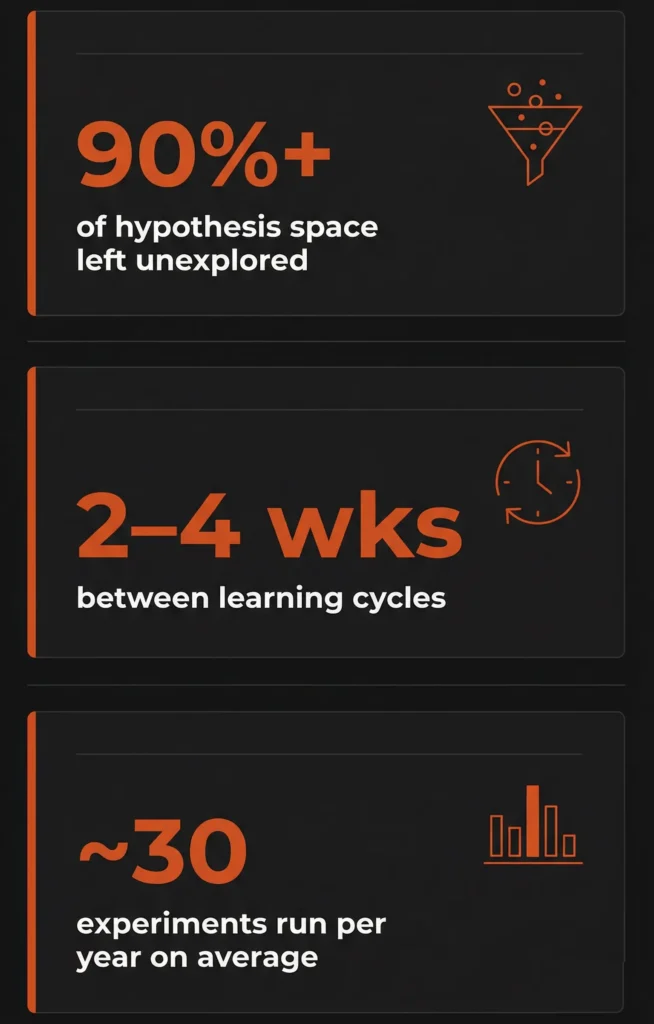
The average enterprise runs fewer than 30 experiments a year. Growth at scale demands continuous discovery across experience, messaging, and incentives — not periodic tests.

The Problem
Marketing runs at human speed in a machine-speed world
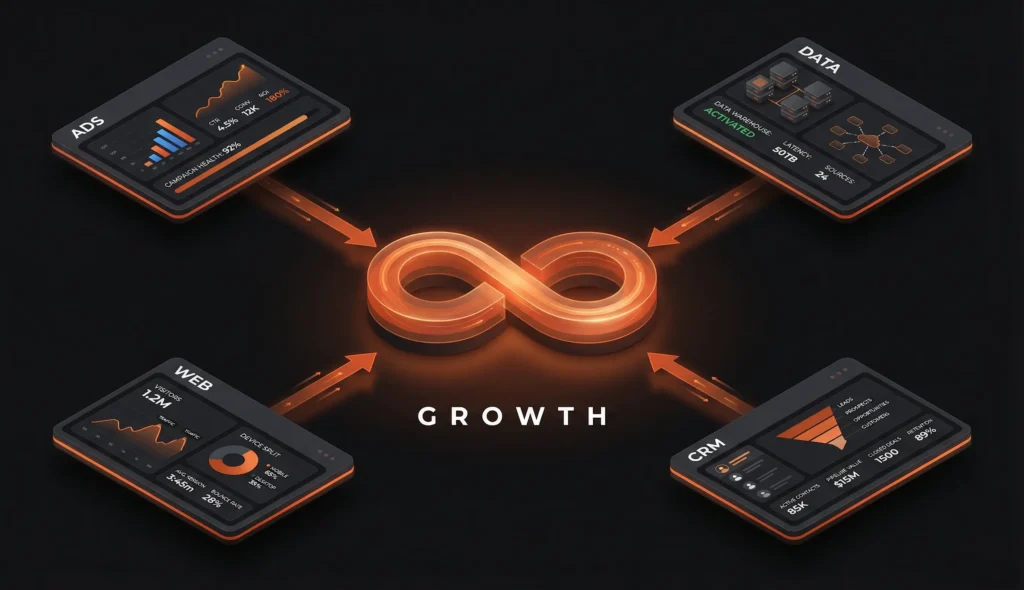
The bottleneck isn't ambition — it's architecture. Hypothesis generation is linear. Data sits siloed. And testing cycles move too slowly to keep pace with how audiences actually behave.
Sequential experimentation
Most growth teams test in isolated cycles — a new landing page here, an ad creative tweak there. The hypothesis space far outpaces what any manual process can explore.
Broken feedback loops
GA4, paid media signals, and engagement data sit siloed. Insights rarely feed back into the next variant automatically. The loop is broken by human handoffs.
Optimizing at human speed
Marketers move at the pace of planning cycles and approval chains, while platforms and audiences shift in real time. Reactive optimization consistently misses revenue.
The Shift
Traditional CRO vs the Tangentix system
Moving from episodic testing to a system that continuously discovers what drives conversion, revenue, and retention.

Traditional CRO
Isolated page testing
- Limited experimentation volume
- Focused on experience changes only
- Manually generated hypotheses
- Insights remain disconnected across tools
- Learning resets after each test

Tangentix System
End-to-end journey optimization
New
- Continuous experimentation at scale
- Full journey optimization across all surfaces
- Signal-driven hypothesis prioritization
- Connected learning across systems
- Learning compounds over time
Intelligence Layers
The three surfaces of growth experimentation
Most programmes over-focus on UX optimization. Messaging and incentive discovery often unlock the largest gains.
Experience Research
Real-time UX/UI optimization
- Friction reduction
- Dynamic checkout flow variants
- Navigation friction removal
- Mobile layout optimization
- Page load & interaction tuning
Page load & interaction tuning
Message Research
Value proposition discovery
- Motivation
- Headline & copy variant testing
- Creative attribute analysis
- Channel-specific messaging
- Cross-channel message propagation
CTR · Open Rate · Conversion Rate
Incentive Research
Minimum viable incentive discovery
- Economic stimulus
- Dynamic discounting algorithms
- Loyalty reward structure tests
- Free shipping threshold modeling
- Cohort-level incentive sensitivity
AOV · Repeat Purchase · LTV
Most experimentation programmes over-focus on UX optimization, while messaging and incentive discovery often unlock the largest gains.
The Engine
The continuous experimentation loop
A four-stage system where every experiment improves the next. Learning compounds — it never resets.
01 — Signal Intake
Data ingestion
Behavioral data from GA4, Meta, Braze, and commerce platforms. AI detects drop-offs and emerging audience patterns.
02 — Hypothesis Generation
AI research engine
LLM agents propose prioritized, testable hypotheses based on friction points and prior learning — not gut feel.
03 — Execution
Multi-surface deployment
Variants deployed across Experience, Message, and Incentive layers with minimal manual design or dev involvement.
04 — Causal Learning
Statistical distillation
Lift feeds back as new priors. Negative results prevent repetitive failures. The system gets smarter every loop.
Use Cases
Where the loop runs
Three high-impact experimentation surfaces — relevant across e-commerce, B2B SaaS, and enterprise growth teams.
01 — Paid media & landing pages
Acquisition optimization
GA4 · Google/Meta Ads · CMS
Test headline, hero, CTA, and social proof variations against high-intent paid traffic. Winning variants promoted to new baseline — continuously.
Conversion Rate
CPL
ROAS
02 — Website UX
Journey optimization
GA4 · Hotjar / Contentsquare · CMS
Read behavioral signals — scroll depth, rage-click, drop-off — and propose layout, copy, and flow variants optimized against downstream conversion.
Session-to-Cart
Form Fills
Bounce Rate
03 — Loyalty & retention
Lifecycle revenue
Braze / Adobe · CDP · CRM
Experiment with offer mechanics, send timing, segmentation logic, and message sequencing to systematically drive next-purchase behavior.
Repeat Purchase
LTV
Engagement
The Model
How AI and humans work together
The system operates freely within boundaries humans define — not the other way around.

What AI does
- Hypothesis discovery at scale
- Pattern detection across data sources
- Variant generation across surfaces
- Experiment insight synthesis

What humans do
- Define experimentation surfaces
- Set the north-star metric
- Enforce guardrails — brand, budget, audiences
- Translate causal learning into strategy

Understand your Growth Opportunity space
We assess where experimentation opportunities exist across your experience, messaging, and incentive layers — and build a prioritized 90-day roadmap aligned to revenue impact.
No commitment. Clear view of your growth opportunity.
60min
Session
Free
No Commitment
Fast
Turnaround
Common Questions
Frequently asked questions
Questions we hear from growth, CRO, and marketing teams exploring continuous experimentation.
Continuous growth experimentation is a system-level approach to CRO that replaces episodic A/B testing with an always-on loop. Behavioral signals from analytics, paid media, and CRM are continuously analyzed to generate, prioritize, and deploy experiments across experience, messaging, and incentive surfaces — with each cycle building on the last.
Traditional CRO focuses on isolated page improvements — typically 20 to 30 tests per year, manually generated, with insights that rarely carry forward. The Tangentix system connects behavioral signals across channels, automates hypothesis generation using AI, and ensures every experiment informs the next. Learning compounds rather than resets.
Growth and performance marketing teams at e-commerce brands, B2B SaaS companies, and enterprise retailers see the strongest results — particularly those with high paid traffic volume, complex customer journeys, or loyalty and retention programs that depend on sequencing and personalization.
The system ingests behavioral and conversion data from GA4, Google Ads, Meta Ads, Braze, Adobe, CDPs, and commerce platforms. Signals from these sources are synthesized into a unified view of friction, drop-off, and opportunity — which feeds directly into hypothesis generation.
Most engagements begin with a 30-day Clarity Blueprint to map experimentation surfaces and quantify the growth opportunity. A 60-day Revenue Acceleration Sprint follows — designing and launching structured experiments with holdout groups to measure true incremental lift.